 Skip to content


How to Remove Fake Tan Stains from Sheets and Clothes (and What Your Self-Tanner Is Really Leaving Behind)
- by Brodie Cook

Okay, so the tan looks incredible. Honestly, the best one you've done. You smoothed it on properly, waited ages for it to dry, and even put on the old pyjamas like a responsible adult.
And then you see the sheets.
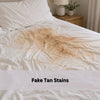
There's a full orange outline of your shoulder on the pillowcase, streaks down the fitted sheet, and somehow your favourite white top now has a bronze collar. You're standing there holding it, wondering whether this is a wash-it-and-pray situation or a throw-it-out one.
Breathe. It's neither, and you don't need to panic-Google anymore. Fake tan stains look like one big orange mess, but they're actually a few different things stuck to your fabric at once. Each one needs a slightly different fix, and that's why the "just chuck it in the wash" approach works on one stain and does nothing to the next. Once you know what you're up against, getting fake tan out of your sheets and clothes is a lot easier than it looks right now.
What's actually staining your sheet?
Most people blame the tan itself. It's a bit more interesting than that.
The active ingredient in self-tanner is DHA (dihydroxyacetone). It's colourless, and it works by reacting with amino acids in the top layer of your skin, so the colour develops over hours. The orange that lands on your pillowcase is mostly something else: the guide colour, a temporary tint that shows you where you've applied product.
Here's how the layers break down:
| Layer | What it is | How to spot it | What lifts it |
|---|---|---|---|
| Guide color | Temporary tint sitting on the surface | Orange-brown; transfers onto a damp white cloth | Cold rinse, then detergent |
| Oily film | The carrier oils that moved the color from bottle to skin to fabric | A greasy or dull patch; a shadow that shows up again once dry | Detergent, plus a warm main wash |
| Bonded color | DHA reacting with a protein fibre (silk or wool) | Brown mark that won't budge onto a cloth | Oxygen-based whitener, or a professional cleaner |
You'll sometimes read that DHA can't stain fabric. On cotton and polyester, that's mostly true, because those fibres lack the amino groups DHA reacts with.
Why it lands where it lands
Transfer isn't random. It shows up on the collar, cuffs, waistband, bra band, and the patch of pillow under your shoulder. Friction, warmth and sweat all meet there.
Time matters too, because your tan is still developing while you sleep. One brand puts development at about 6 to 8 hours, and Clarins says some formulas carry on for up to 24. Your bottle's instructions beat any general number.
The guide colour leaves early, and DHA keeps working underneath it. With express formulas, the first shower removes the transferable tint while the tan carries on developing. Treat the rinse and the development as separate stages. If your formula allows it, a rinse before bed is the biggest single fix for stained sheets.
How to remove fake tan stains while they're fresh
Here's the order that works best on washable sheets and clothes:
- Do the white cloth test. Press a damp white cloth on the mark and blot. If colour lifts, it's still loose surface colour, which is good news. Lift any blobs with the edge of a spoon first, and don't rub, because friction pushes the tint deeper.
- Rinse from the back with cold water. This flushes the colour out the way it came in. Warm water and heat can set the tint, so keep both away until the stain is gone.
- Degrease. Work a small drop of liquid laundry detergent, or a laundry stain remover suited to the fabric, in from the outside edge toward the middle. Leave it a few minutes, then rinse well.
- Wash warm, if the care label allows. Cold was for the rinse. The oily film needs some warmth to release.
- Wash the stained piece on its own or with similar colours. Loosened tint can settle onto a whole load of whites, which is worse than the original spot.
- Air-dry and check in daylight. Wet fabric hides stains, and the dryer will bake in anything left.
Still there after washing? Try oxygen, not chlorine

A stain that survived a wash, or even a dryer, isn't automatically permanent. It's just stubborn. This is where an oxygen-based whitener earns its place. It breaks down colored compounds through oxidation instead of stripping fibres.
Chlorine bleach is the opposite move. Several laundry guides warn against it on self-tanner marks because it's harsh on fibres and can make the mark worse. And never mix bleach with vinegar, which some home remedies use, because the combination releases toxic gas. Our pillar guide on how to whiten clothes without chlorine bleach covers the reasoning.
Our UV Whitening Sheets combine an oxygen bleach system (PAP + TAED), protease enzymes that target protein-based residue like sweat and skin, and a purple dye blend that offsets yellowing. They aren't a detergent, so use them alongside yours.
- Soak: dissolve one sheet in 4 litres of water and soak for up to two hours. Scale up for bigger tubs (12 litres needs three sheets).
- Wash: run your usual detergent plus a second sheet.
- Skip them on wool, silk, leather and cashmere.
To be straight with you: purple cancels yellow, not orange. It won't erase a strong tan mark on its own, and we haven't run lab tests specific to self-tanner. What it does well is lift the yellow-brown shadow that can linger once the main colour is gone.
Judge progress the right way. Photograph the spot in the same light after each wash. If it's smaller or paler, another round is worth it. If it's barely changed after two or three, stop and ask a professional cleaner.
Fabric changes the rules
Not every fabric reacts the same way. Here's a quick guide:
| Fabric | Why it behaves this way | What to do |
|---|---|---|
| Cotton and linen (sheets, tees, towels) | Absorbs colour fast but usually releases with soap and an oxygen soak | Follow the fresh-stain steps, then an oxygen soak if needed |
| Polyester, microfiber, activewear | Tends to grip oily residue, and tight knits hold on | Give the pre-treat extra time before washing |
| Silk (including silk satin) | Protein fibre, so DHA can bond to it | Blot only, and go to a professional cleaner quickly |
| Wool and knits | Protein fibre, easily damaged by rubbing | Same as silk, and don't use oxygen soaks |
| Satin | A weave, not a fibre, so check the label: it could be polyester or silk | Treat according to the fibre |
| Carpet and mattress | Can't be rinsed and drained like a sheet | Lift with a spoon, blot, use a carpet-safe cleaner after a hidden-spot test |
For a wedding dress or any dry-clean-only garment, tell the cleaner it's a self-tanner or spray tan stain, how old it is, and what you've already tried. If the tan is for a wedding, ask your tan artist about the formula and the first-rinse timing, and step into the dress only when your skin is fully dry.
Hotel sheets and towels
Towels behave like cotton sheets, so use the same steps. On the road, tell housekeeping quickly that it's self-tanner and ask about the property's policy. Some hotels charge for staining, and being upfront usually goes over better than a surprise on your bill.
Stopping the next stain during the development period
Prep and protection both help:
- Exfoliate and moisturise first. Dry patches grab colour unevenly, so good skincare gives you a smoother base.
- Apply thin layers with a mitt or sponge, and let each area dry completely before you dress.
- Wear loose, dark sleepwear, and put a spare towel over your pillow.
- Keep a "tan night" sheet set in dark colours or ones you don't mind sacrificing.
- Skip sweaty workouts while the tan is still developing.
- Wash your pillowcase more often during tan week.
A few stain removal questions before the next wash
Can I use a fake tan remover made for skin?
Choose a product labelled for laundry. A skincare remover is designed for skin, and its suitability for clothing cannot be assumed. The same goes for a scrub or exfoliating mitt: neither belongs in your fabric stain treatment.
Will washing-up liquid remove fake tan stains?
It may help with oily residue on a suitable washable fabric, but laundry pre-treatment gives you instructions intended for clothes. If you use washing-up liquid, rinse it out thoroughly before machine washing. ACI advises against putting it in an automatic washer.
What about fake tan on carpet?
Lift excess product and blot gently. Use a carpet-approved stain remover after a hidden-area test, following its instructions. Don’t pour a laundry soak onto carpet or a mattress; you cannot rinse and drain them like a sheet.
What should I do about stained hotel sheets?
Tell housekeeping promptly and explain that the mark is self-tanner. Leave treatment to them rather than trying bathroom products on their linen. If you are worried about a charge, ask about the property’s policy. There is no single rule for every hotel.
Finding a tan mark doesn’t have to mean giving up on your favourite whites. Treat it while it’s fresh, let the fabric label guide you, and check the result before the dryer turns a small laundry job into a stubborn one.

)